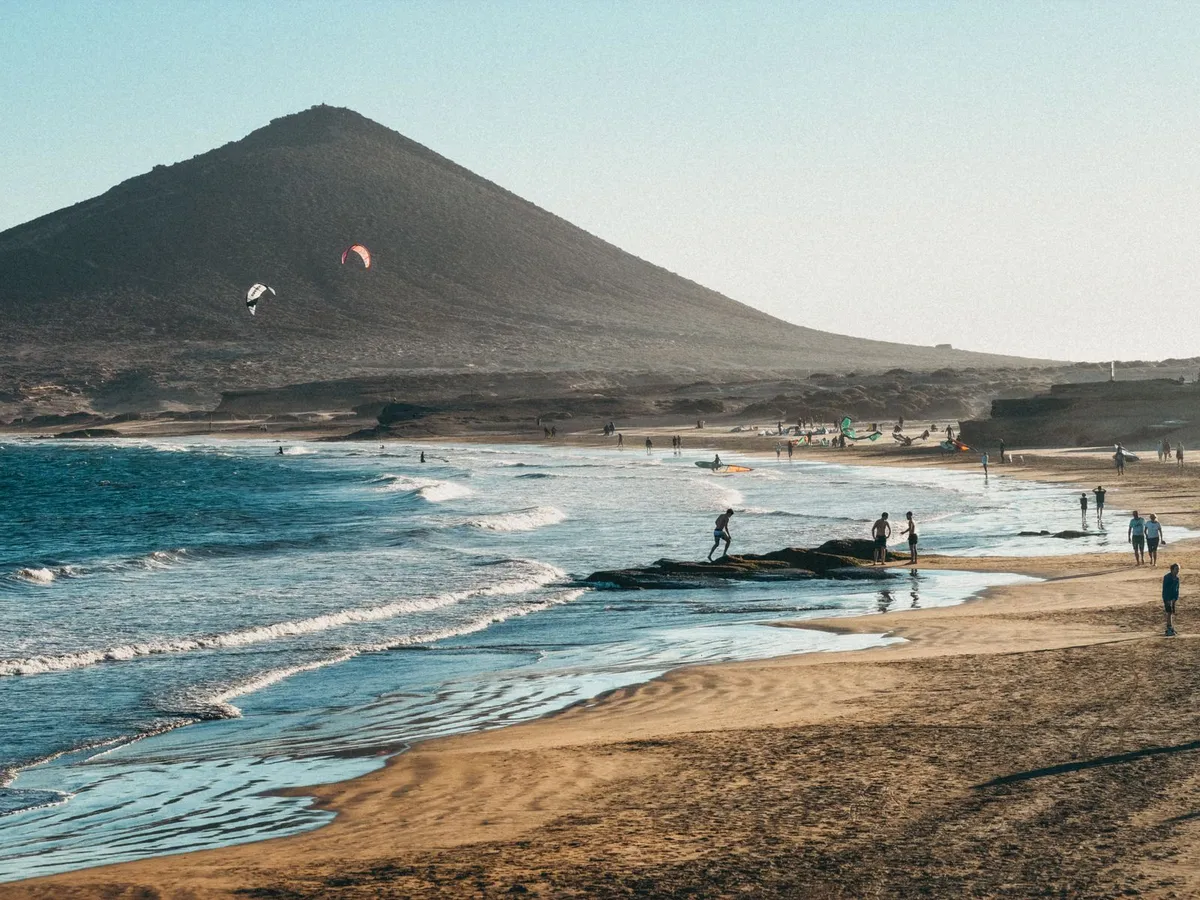
Yes, Tenerife works for digital nomads. Fast fibre, a mild year-round climate, and an established remote-work community back that up. The catch the holiday advice misses: skip the Costa Adeje resort strip. The nomad bases are El Médano in the south and Puerto de la Cruz or La Orotava in the north. This guide scores those bases against the things that matter when you actually work here, then covers real monthly costs in euros, wifi and coworking, Spain's digital nomad visa, weather by region, community, and who should skip the island entirely. Every cost and visa figure is dated. Last updated August 2026.
Choosing a base
The base decision: north vs south for nomads
Start with the mistake most people make. The standard holiday advice points you to Costa Adeje and Las Américas, the purpose-built resort strip 15 to 20 minutes from the airport. For a two-week tan it works fine. To live and work, it is the wrong call: tourist grocery prices, restaurants built for one-week visitors, and a smaller nomad community than Tenerife's main remote-work bases to plug into. It is generally more expensive than the other bases on this list, especially accommodation and dining. The strip does luxury and adults-only hotels well for a holiday, and the Costa Adeje guide covers it if a short resort stint is part of your trip. Just don't try to build a working month around it.
The real bases are three towns the brochures mostly ignore. Here is how they score against the criteria that actually matter to a nomad.
| Base | Region | Monthly cost | Nomad community | Fibre / wifi | Everyday vibe | Beach | Coworking supply |
|---|---|---|---|---|---|---|---|
| El Médano | South | Lower | Growing, surf-led | Fibre in town, verify per address | Bohemian surf town, constant wind | 2 km natural beach | Low to moderate |
| Puerto de la Cruz | North | Mid | Moderate, established | Fibre plus laptop cafés | Colonial port, green, cooler | Black sand, lava pools | Moderate |
| La Orotava | North | Lowest | Small, coliving-centred | Fibre in town | Historic mountain town, slow | None | One coliving-coworking |
| Resort strip (Costa Adeje / Las Américas) | South | Highest | Smaller nomad community than Tenerife's main remote-work bases | Fibre available in many properties — verify the specific address | Tourism bubble | Groomed resort beaches | None dedicated |
Pick south if you want beach mornings, a 10-minute airport run, and a surf-and-kite crowd. Your base is El Médano, the last south-coast town without a hotel zone, and one of the few that still feels un-resort-like. The trade-off is wind. It barely stops here, the island's windsurfing capital, so if you need dead-calm video-call days this is not the spot.
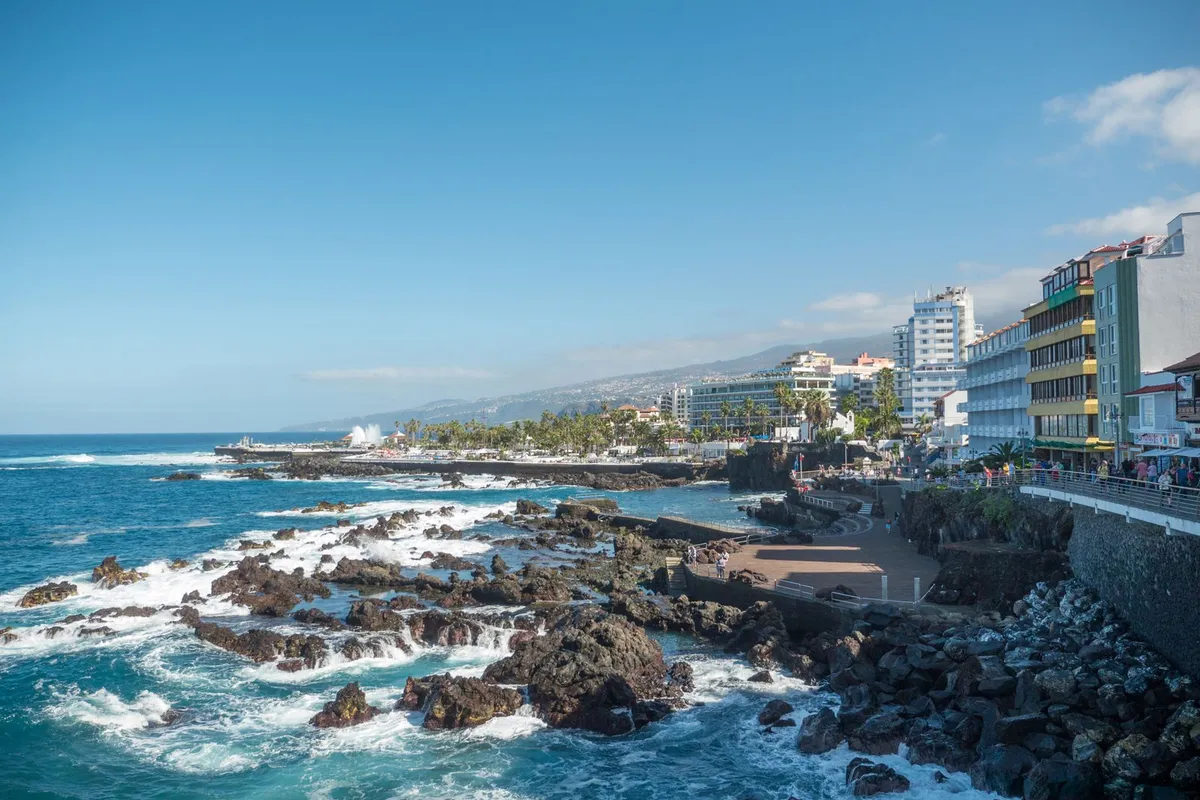
Go north if you want the greenest, most walkable town and the deepest local life. Puerto de la Cruz has hosted long-stay visitors since the first Canarian hotel opened here in 1880, and it shows: coworking exists, the centre is walkable, the climate is cooler. Choose La Orotava instead if you want the lowest rent and the most authentic day-to-day, and you are happy to run a car.
Once you have picked a base, long-stay apartments and aparthotels are where the value sits for a month or more.
Working setup
Working from Tenerife: wifi, coworking and coliving
Fibre to the home covers most urban areas north and south, including El Médano, Puerto de la Cruz and La Orotava. Apartment speeds of 100 to 600 Mbps are common through Movistar, Digi and Orange. One rule before you sign anything: confirm fibre at the specific address, because rural and some coastal pockets still lean on 4G or 5G. Keep a mobile hotspot as call backup either way.
On shared space, supply is thinner than a mainland city, so treat these as verified-open options rather than a ranked list. Work 'n Mates sits in the middle of El Médano, five minutes' walk from the beach: eight desks, fibre, a small kitchen and a booth for video calls. It rents by the month and is built for people staying two to three months or longer, not for a week of laptop tourism. Fair warning: eight desks is eight desks. Ask before you arrive.
Further up the coast in Abades, Kora Nivaria Beach has a coworking space, but it is an aparthotel with a kids' club rather than a coliving, and it is a twenty-minute drive from the nearest lively town. Rooms start from €120 per night (checked December 2025) and no monthly rate is published. Ask directly if you want one.
In Puerto de la Cruz, the picture is a mix of independent coworking spaces and genuinely laptop-friendly cafés with solid wifi. More than El Médano offers, less than a big city.
La Orotava has one option and it is a good one. Gato Azul is a coliving and coworking in a 300-year-old house in the historic centre, running three separate work areas, a conference-call room and a 500 Mbps line, for a community of up to twenty. It publishes long-stay discounts on its own site: 20% off from seven days, 30% from twenty-eight, 50% from sixty (checked July 2026). Book a month there and the rent maths on the north starts to look different.
The budget
What it costs to live in Tenerife as a nomad
Here is a realistic monthly budget per person, in euros, split into a lean tier and a comfortable one. These are editorial planning estimates compiled July 2026 — our own figures, not sourced or government data — and they are volatile, so treat them as a planning baseline, not a quote.
| Category | Budget | Mid-range |
|---|---|---|
| Rent (1-bed, long-stay) | €550–800 | €900–1,300 |
| Coworking desk | €0–100 | €100–200 |
| Groceries and meals | €250–350 | €400–550 |
| Transport | €30–50 | €80–150 |
| Utilities | €80–120 | €80–120 |
| Total per month | €910–1,420 | €1,560–2,420 |
El Médano and La Orotava sit at the lower end of rent, Puerto de la Cruz in the middle. Base yourself on the Costa Adeje strip and it is generally more expensive, especially accommodation and dining. The single biggest lever is transport: stay bus-only in the south and you spend €30 to €50 a month, run a car in the north and it climbs past €80.
The visa
Spain's digital nomad visa: the numbers that trip people up
If you hold an EU passport, you do not need this. You can live and work in Tenerife freely. Everyone else running a non-Spanish income stream will likely want Spain's Digital Nomad Visa, and the figure that matters is income.
A single applicant must show €2,849 per month, which is 200% of Spain's minimum wage, or €34,188 a year. The working matters, because this is the figure people get wrong most often — 200% of the annual SMI: €17,094 × 2 ÷ 12 = €2,849/mo. The annual SMI is paid across 14 instalments, not 12, so doubling the monthly minimum wage gives you €2,442 and an application built on the wrong number. Add a first dependent and the threshold rises by €1,069 per month, then €357 for each additional family member. The visa runs one year through a consulate, or three years if applied for in-country, and it is renewable to a five-year total.
Family income requirements (2026)
Minimum monthly income required for Spain's Digital Nomad Visa based on the 2026 Minimum Interprofessional Salary (SMI).
| Household | Minimum monthly income | Minimum annual income | Calculation |
|---|---|---|---|
| Applicant only | €2,849 | €34,188 | Base income |
| Applicant + spouse | €3,918 | €47,016 | €2,849 + €1,069 |
| Applicant + spouse + 1 child | €4,275 | €51,300 | €2,849 + €1,069 + (1 × €357) |
| Applicant + spouse + 2 children | €4,632 | €55,584 | €2,849 + €1,069 + (2 × €357) |
| Applicant + spouse + 3 children | €4,989 | €59,868 | €2,849 + €1,069 + (3 × €357) |
Income thresholds are calculated from Spain's Minimum Interprofessional Salary (SMI). Because the SMI may change, these figures should be verified against the latest official guidance before submitting an application.
Income calculator
Digital Nomad Visa Income Calculator
Last verified 10 July 2026Choose your household to see the minimum income required. Everything updates instantly and nothing you enter is saved.
Select your household size to calculate the minimum income required.
Can I qualify?
Enter your monthly income to compare it against the selected requirement. This happens entirely in your browser — nothing is sent or stored.
Select a household size above to check whether your income qualifies.
How these figures are calculated
Spain's Digital Nomad Visa income requirement is linked to the country's Minimum Interprofessional Salary (SMI). The minimum applicant income equals 200% of the SMI, calculated on the ANNUAL figure — 200% of the annual SMI: €17,094 × 2 ÷ 12 = €2,849/mo. Note that the annual SMI is 14 payments, not 12, so doubling the monthly SMI gives the wrong answer. Additional accompanying family members increase the required income according to current government rules. Because the SMI can change, these values are reviewed whenever Spain updates the minimum wage, typically each February.
2026 SMI: €1,221/month (€17,094/year across 14 payments) · Source: BOE Real Decreto 126/2026 · Last verified 10 July 2026.
Two details catch people out. No more than 20% of your income can come from Spanish clients. And on the Beckham Law flat 24% tax rate: the 24% rate is available to employed remote workers under the Beckham regime. Most self-employed autónomos are excluded in practice — the Spanish Tax Agency draws a hard line — though a narrow entrepreneur route under the Startup Law (Law 28/2022) can qualify some. Verify your specific case with a gestor before assuming eligibility. Core requirements include a non-Spanish employer or clients, a company trading for over a year, at least three months of seniority, full private health insurance with no co-pays, a clean five-year criminal record, and either a degree or three or more years of relevant experience.
The 2026 reality worth knowing: enforcement has reportedly tightened. Immigration specialists report that, as of 2026, converting from a Non-Lucrative Visa to the DNV from inside Spain is no longer accepted — you'd need to reapply from outside. Strict six-month physical-stay verification and an active fraud crackdown are also reported by immigration specialists in 2026. Treat all three as practitioner reports rather than published policy, and confirm your own case before you rely on them. The income and wage figures above are a separate matter: those come from Ministerio de Inclusión, Seguridad Social y Migraciones (UGE-CE), with the wage figure from BOE Royal Decree 126/2026. Checked July 2026. These thresholds are tied to Spain's SMI and are recalculated whenever the government updates it, typically early each year, so verify the latest figures before you apply.
Weather
Weather and when to come
Eternal spring is mostly real. There is a north-south split underneath it, and you should plan around it.
South coast readings, from the AEMET station at 64 m on the 1991 to 2020 normals, run from average highs of 21°C in January to 29°C in August. Rain is close to nothing from May through August and peaks near 30 mm in December, roughly 115 mm across the year. The sea sits around 19°C in winter and 23 to 24°C by September (Puertos del Estado buoy data). July is the sunniest month at about 10 hours a day.
Up north it is a different climate, greener and wetter. The nearest long-run normal comes from an upland station at 632 m on the older 1971 to 2000 period, so read it as an uplands figure: coastal Puerto de la Cruz runs roughly 2 to 3°C warmer than those numbers, and the two tables are not strictly like-for-like given the different periods. Expect more cloud and more rain than the south, around 214 mm a year at that station, in exchange for the lush valleys that make the north worth basing in.
For a month-by-month breakdown, see our Tenerife weather by month guide. If you want warm sea and empty rain columns, aim May to September in the south. If you want mild working weather without the summer heat, the shoulder months suit the north.
Community
Community, meetups and landing softly
You will not be the only laptop on the island. The main hub is the Facebook group Tenerife Remote Workers and Digital Nomads, and it is the fastest way to find flatshares, meetups and the current state of any coworking space before you arrive. Beyond Facebook the same community runs a Meetup group and a Slack. If you want people rather than a desk, Gato Azul in La Orotava is the most community-shaped option on the island. It caps at twenty residents, which is the point.
For landing, most nomads fly into Tenerife South (TFS), which sits 10 to 20 minutes from the southern bases and about an hour from the north. Sort the first ride before you touch down. Our Tenerife South airport transfers guide covers the bus and taxi options and current fares.
Do you need a car? In the south, no. El Médano to the airport is a 10-minute run and TITSA buses cover the strip cheaply. In the north, effectively yes. Puerto de la Cruz is walkable, but La Orotava and the wider valley really want a car, and public transport there means changing buses. For stays of months rather than weeks, a long-term rental beats daily rates.
See also our guide to renting a car long-term.
Weekends off
Weekends off: what to actually do
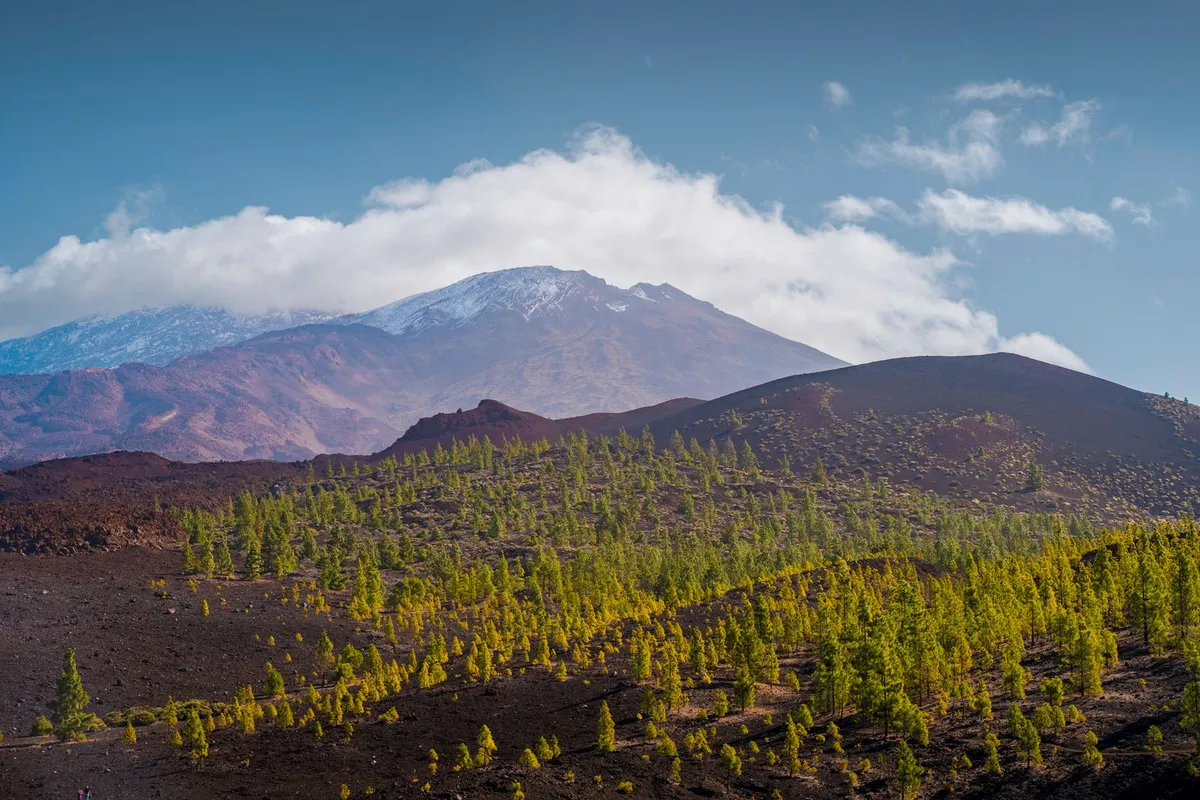
Weekends here are absurd value. Drive up to Teide National Park for Spain's highest peak at 3,718 m and hiking that looks like another planet, ideally taking the Teide cable car to La Rambleta at 3,555 m for the summit views. The same altitude that keeps the park above the cloud line makes it one of Europe's best stargazing spots after dark. Off the south coast, whale and dolphin watching runs year-round thanks to a resident pilot-whale population in the strait toward La Gomera, with boats leaving from Puerto Colón and Los Cristianos.
From Los Cristianos you can also ferry to La Gomera in about 50 minutes for a full day on a wilder, greener island. And when you just want a pool day, Siam Park in Costa Adeje is the one resort-strip attraction genuinely worth the trip.
A boat trip or a Teide sunset is worth booking ahead so you get the time slot you want.
Not for everyone
Who should skip Tenerife as a nomad
Tenerife is not the right base for everyone, and here is who should look elsewhere.
If you are non-EU and cannot meet the €2,849-a-month visa threshold (200% of the annual SMI — see how this is calculated), a long stay gets complicated fast, and the 90-day Schengen limit will cut your trip short. If you hate driving, the north will frustrate you: outside Puerto de la Cruz you will lean on a car, and La Orotava without one is limiting. And if what you actually want is the all-inclusive resort experience, you will end up on the Costa Adeje strip, paying tourist prices in a bubble with a smaller nomad community than Tenerife's main remote-work bases, which is the opposite of why most people go nomad in the first place.
One long-stay practical worth sorting early is healthcare. EU visitors can use an EHIC for state care, UK visitors a GHIC, but anyone here past 90 days should arrange proper private cover. Our guide to the island's hospitals in Tenerife shows where to go if you need it. If Tenerife is the right fit, the base matrix near the top is where to start.
Good to know
Frequently asked questions
Is Tenerife good for digital nomads?
Yes. Fast fibre in the main towns, a mild year-round climate, and an established remote-work community make it a strong base. The one caveat: choose a nomad town like El Médano or Puerto de la Cruz rather than the Costa Adeje resort strip, where prices are higher and community is thin.
Where do digital nomads live in Tenerife, north or south?
Both work, for different people. El Médano in the south gives you beach, sun and a 10-minute airport run, with constant wind as the trade-off. Puerto de la Cruz and La Orotava in the north are greener, cooler and cheaper on rent, but you will usually want a car.
How much does it cost to live in Tenerife as a nomad?
A lean single-person budget runs roughly €910 to €1,420 a month, and a comfortable one €1,560 to €2,420. These are editorial planning estimates, not sourced or government data, compiled July 2026. Rent is the biggest variable, from around €550 for a long-stay one-bed at the low end to €1,300 mid-range. Basing on the Costa Adeje strip is generally more expensive, especially accommodation and dining.
Do you need Spain's digital nomad visa to work from Tenerife?
Only if you are non-EU and want to stay beyond 90 days. EU citizens can live and work in Tenerife with no visa. Everyone else running non-Spanish income generally needs Spain's Digital Nomad Visa, which requires showing €2,849 a month as a single applicant (200% of the annual SMI — see how this is calculated), checked July 2026. The annual SMI is 14 payments, not 12, so doubling the monthly minimum wage gives €2,442, which is the wrong figure.
Related on TenerifeTourism
Sources for this guide: Spain's Ministerio de Inclusión, Seguridad Social y Migraciones (UGE-CE) for Digital Nomad Visa rules, with the income threshold pegged to the minimum wage in BOE Royal Decree 126/2026; AEMET climate normals (south coast station, 1991–2020; north upland station, 1971–2000); and Puertos del Estado buoy data for sea temperatures. The monthly cost-of-living figures are our own editorial planning estimates, not drawn from any of these sources. Enforcement and Beckham-regime practice are reported by immigration specialists, not published policy. Figures verified at time of writing, July 2026.
About our research
TenerifeTourism.com is an independent travel research hub. Our editorial team compiles each guide from official sources — the TITSA transport authority, the Canary Islands tourism board, and hotel operators' own data — and we flag clearly when a detail is confirmed versus estimated. Read our full methodology.