No, Tenerife is not expensive by Western European standards. Budget travellers spend around $90 to $100 a day (€80 to €90), a comfortable mid-range trip runs $220 to $260 (€200 to €235), and luxury starts near $550 (€500) and climbs. The catch is location, not the island. The resort strip is where the cost hides. Step one street back and Tenerife turns cheap.
Prices checked July 2026. All figures are ranges and examples, not guarantees.
The real answer
What actually drives the cost in Tenerife
Tenerife is not one price. It is two, and the deciding factor is where you stand when you pull out your wallet.
There is a budget reality: local barrios away from the seafront, guachinches serving carne fiesta and house wine for under $18 (€16), and a TITSA bus that moves you across the south for the price of a coffee. Live here and Tenerife is one of the cheaper places you can spend a week in Europe.
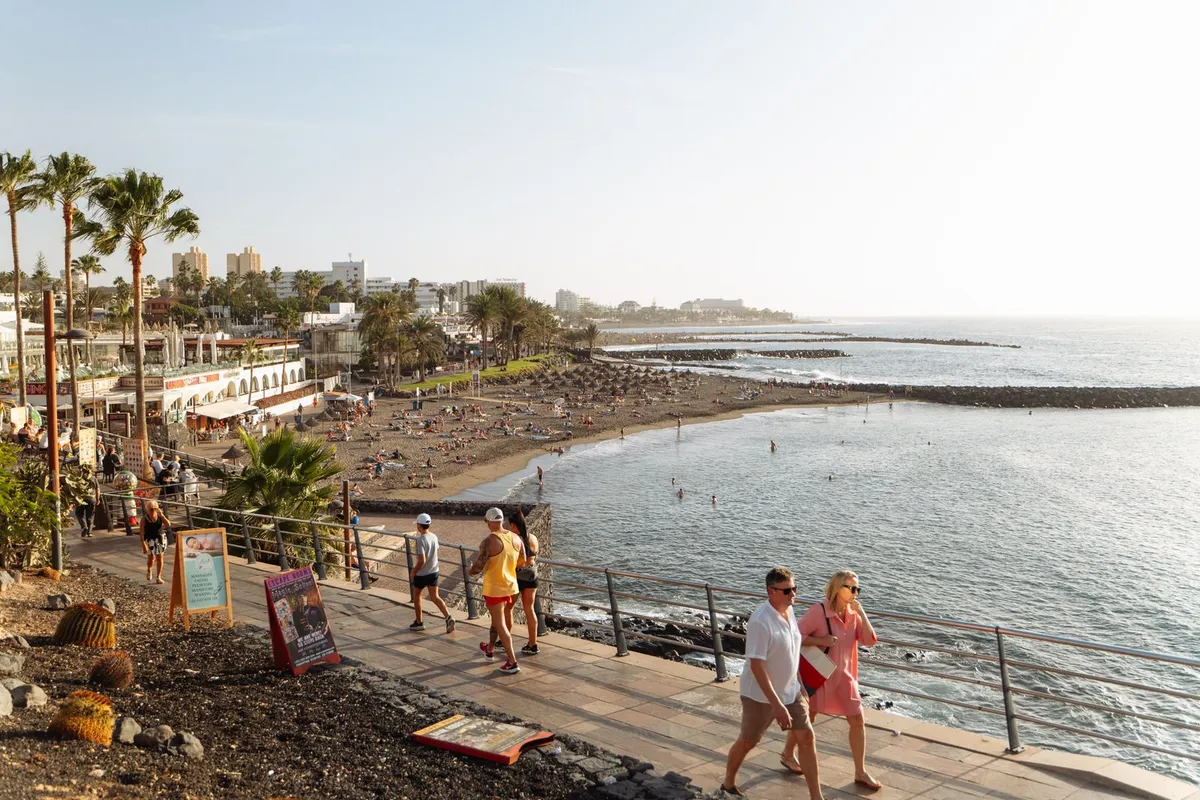
Then there is the splurge reality: the resort strip through Costa Adeje and Playa de las Américas, where an ocean-view table, a beach-club sunbed and a poolside cocktail stack up fast. Resort-zone restaurants run 20 to 30 percent above equivalent local venues, and a prime sea-view spot can charge 40 to 50 percent more for the same plate.
Neither is a trap if you know which one you are choosing. The visitors who complain Tenerife is dear almost always spent the whole week inside the second reality without realising the first one was a five-minute walk away.
At a glance
Daily spend by tier: budget, mid-range and luxury
Here is the whole thing on one screen, per person per day, so you can find your tier in a single scan. USD first, euros in brackets, since that is what you actually pay on the island.
View data as a table
| Category | Budget | Mid-range | Luxury |
|---|---|---|---|
| Accommodation | $30–40 (€27–35) | $90–120 (€82–110) | $250–450 (€230–410) |
| Food | $25–30 (€22–27) | $50–65 (€45–60) | $100–140 (€90–125) |
| Transport | $8–12 (€7–11) | $15–25 (€14–23) | $40–70 (€36–64) |
| Activities | $10–15 (€9–13) | $30–45 (€27–41) | $80–150 (€72–135) |
| Daily total | $90–100 (€80–90) | $220–260 (€200–235) | $550–700 (€500–635) |
The jump from budget to mid-range is mostly accommodation and eating out, not activities. The jump from mid to luxury is almost entirely the hotel. Where you sleep is the single biggest lever on your daily number.
Where you sleep
Accommodation costs
Accommodation is the line that decides your tier, so it is worth getting right before anything else.
Budget beds run $35 to $65 a night (€32 to €60): hostels, two-star hotels, guesthouses and well-priced aparthotels, concentrated in Puerto de la Cruz and Los Cristianos. Mid-range sits at $90 to $130 (€82 to €118) for a solid three or four-star or a good aparthotel in the standard Costa Adeje and Las Américas resorts. Luxury opens around $250 (€230) and runs past $550 (€500), with the Ritz-Carlton Abama near the top from roughly $540 (€500). These ranges are volatile and move with demand, so treat them as a guide and check live rates for your dates.
For the top end, the five-star cluster above Playa del Duque is where those $250-plus nights concentrate, and it is worth comparing luxury hotels in Costa Adeje against each other rather than booking the first name you recognise.
Couples travelling without children can strip the family-resort premium and noise out of a stay entirely by choosing adults-only hotels in the south.
On the bottom tier, the guesthouses and aparthotels of Los Cristianos and Puerto de la Cruz hold the $35 to $65 line, and these budget hotels in Tenerife are where the genuine savings live for anyone not chasing a pool complex.
Eating out
Food and drink costs, and the north-south split
Eating out is where Tenerife feels cheap or dear depending entirely on which door you walk through.
A main course at a local neighbourhood restaurant costs $10 to $14 (€9 to €13). The same dish on the resort strip is $15 to $25 (€14 to €23), and at an ocean-view spot it climbs to $20 to $35 (€18 to €32). A guachinche, the traditional Canarian tavern found mostly in the north, feeds you a full meal with local wine for $10 to $18 (€9 to €16). The three-course menú del día is the value play at $10 to $14 (€9 to €13).
The everyday items are where the island quietly rewards you. Coffee is $1.10 to $1.45 (€1.00 to €1.30), a cortado $1.65 to $2.75 (€1.50 to €2.50), a local beer at a bar $2.75 to $5.00 (€2.50 to €4.50), and a bottle of local wine from a supermarket $3.30 to $7.70 (€3.00 to €7.00). Self-catering, a week's basic shop for one person runs $55 to $75 (€50 to €68).
Here is the redirect most guides skip. The south resort areas run 20 to 30 percent higher than northern and residential venues for the same quality, and the guachinches and local menús cluster in the north around Puerto de la Cruz, La Laguna and Tacoronte. You do not have to cross the island to feel it. Walk one street back from any seafront promenade and the same meal drops noticeably, because that kitchen feeds locals, not the passing crowd.
Transport
Getting around: transport costs
Transport is the cheapest line on your budget if you use the buses, and it stays reasonable even if you do not.
A single TITSA bus fare is $1.60 to $1.75 (€1.45 to €1.60) for a short hop, rising with distance on intercity routes. The Ten+ rechargeable card cuts roughly 40 percent off cash fares, costs $2.20 (€2.00) to buy, and is shareable across several passengers, which makes it the obvious first purchase for any group. A day pass is $11.00 (€10.00), a seven-day pass $55.00 (€50.00). A short taxi hop around town runs $8 to $15 (€7 to €14).
Car hire is $30 to $45 (€27 to €41) a day in low season and $55 to $75 (€50 to €68) in high season, with the cheapest local operators from around $25 (€23). From Tenerife South airport to Costa Adeje, the roughly 20 km run costs $4.05 (€3.70) by bus, $30 to $35 (€27 to €32) by metered taxi, or $27 to $35 (€25 to €32) for a pre-booked private transfer. The bus is the value option, the private transfer the convenience one, and the taxi sits between them, laid out in full in our Tenerife South airport transfers guide.
Days out
Activities and attractions: what you will actually pay
Activities are where a careful traveller and a splurging one look almost identical, because the island's best days out are cheap or free.
Siam Park, the water park in Costa Adeje, is $48 to $53 (€44 base, €48 in the July to August peak) for a one-day adult ticket. The Teide cable car return is $44 (€40) for a non-resident adult, or $26 (€23.50) one-way. A whale-watching tour of two to three hours runs $33 to $52 (€30 to €47) on a standard catamaran, more for a small-group yacht.
One thing to get right, because outdated sources get it wrong: the Teide summit is not free for non-residents. Since 19 January 2026 the Telesforo Bravo trail to the top requires a permit costing $16 (€15), or $11 (€10) on a guided walk, with children under 14 free. Anyone telling you the summit is free is reading a stale page; the full detail sits in our Teide cable car and summit guide.
The free column is genuinely long. Every public beach, the Anaga Rural Park trail network, general access and the drive-through of Teide National Park, the Los Gigantes cliff viewpoints, and self-guided walks around Santa Cruz and La Laguna all cost nothing. The night sky is the best free show of all, and knowing where to see it makes the difference.
Watch for
Hidden costs and tourist traps
The gap between people who call Tenerife cheap and people who call it dear usually lives in the small charges nobody quotes upfront.
Sunbeds are the classic one. A basic lounger and umbrella on a public beach is $5.50 (€5.00) per item, so a couple wanting two beds and shade is paying to sit on sand that is otherwise free. Beach-club packages push that to $33 to $99 (€30 to €90) per person once a minimum spend is attached.
Resort-strip markup is the second. That 20 to 30 percent premium on food, plus the sea-view surcharge of 40 to 50 percent, compounds across a week of not walking inland.
Season is the third. School holidays, Christmas, New Year and Easter add 20 to 35 percent to accommodation and car hire, while the shoulder months of May, June and September sit 20 to 30 percent below peak. Move your dates by a fortnight and the whole trip re-prices. None of these are hidden if you plan for them, which is the entire point.
In context
How Tenerife compares
Tenerife holds up well against the obvious alternatives, and the tax system is quietly on your side.
Against mainland Spain, the island runs around 14 to 21 percent cheaper overall, with dining 20 to 30 percent lower and rent 25 to 35 percent lower, though groceries land roughly level once imported items are counted. Against the United States, the direction reverses hard: a typical US city runs about 72 percent higher on overall cost of living than Santa Cruz de Tenerife, with restaurants near 39 percent more and groceries around 53 percent more.
For UK readers wondering in pounds, a week here typically costs less than a comparable week in the Balearics and considerably less than London or Edinburgh once dining and transport are in the sum. Alcohol and fuel are the standout savings, thanks to the Canary IGIC rate of 0 to 7 percent against UK VAT at 20 percent.
Worked example
Sample budget: is $1000 enough for a week?
Short answer: yes, comfortably, if you make budget choices, and tight if you insist on a full mid-tier week.
A lean mid-tier week in shoulder season stacks up like this: a budget room at about $55 a night comes to $385, self-catering roughly 60 percent of meals lands near $210, buses only run about $50, one paid activity plus two free ones sits around $80, and extras add $50. That totals about $775, leaving a real buffer for a second activity or one proper dinner out.
Push to a standard mid-tier week, though, and the maths changes. Accommodation at $110 a night is $770 on its own, food at $55 a day adds $385, and once transport, three headline activities and extras go in, the honest figure is closer to $1,400 to $1,600 per person including a buffer.
So $1,000 is not a stretch, it is a choice. Budget room, self-catering and free trails, and you finish the week with money in hand. Resort strip and daily dining out, and $1,000 covers roughly five days rather than seven.
Strategy
Where to save vs where to splurge
The trick to Tenerife is not spending less everywhere. It is spending nothing where it does not matter so you can spend freely where it does.
Save on: self-catering breakfasts and half your dinners, the Ten+ bus card instead of taxis or hire, restaurants one street back from any promenade, shoulder-season dates over school holidays, and the island's free trails and viewpoints, which cost nothing and outclass most paid attractions.
Splurge on: one genuinely good ocean-view meal you will remember, Siam Park if you have children or like water parks, a small-group whale-watching boat over the packed catamaran, and a few nights on the resort strip if beach-on-your-doorstep is the point of the trip. Spend where the memory is, not where the habit is.
Verdict
The bottom line: is Tenerife expensive?
No. Tenerife is an affordable island wearing an expensive costume in a few square kilometres of resort strip.
Budget it at $90 to $100 a day (€80 to €90) and you will eat well and move freely. Sit at $220 to $260 (€200 to €235) and you get comfortable rooms, restaurants and a full activity list. Only the luxury tier from $550 (€500) asks for real money, and even that undercuts most comparable Western European destinations. The island does not decide your bill. Your postcode within it does.
Once you have your tier, accommodation is the number worth pricing hardest, since it moves your daily total more than anything else.
If your dates are flexible, shifting into the shoulder months is the single cleanest saving on the whole trip, so it pays to check month-by-month conditions and pricing before you lock dates.
Good to know
Frequently asked questions
How much does a meal cost in Tenerife?
A main course is $10 to $14 (€9 to €13) at a local restaurant, $15 to $25 (€14 to €23) on the resort strip, and $20 to $35 (€18 to €32) at an ocean-view spot. The three-course menú del día is the best value at $10 to $14 (€9 to €13), and a guachinche meal with local wine runs $10 to $18 (€9 to €16).
Is $1000 enough for a week in Tenerife?
Yes, on budget choices. A budget room, self-catering most meals, buses over taxis and a mix of free and paid activities lands around $775 for the week, leaving a buffer. A full mid-tier week with daily dining out and headline attractions runs closer to $1,400 to $1,600 per person, so $1,000 covers roughly five of those days rather than seven.
How much money do I need for Tenerife?
Budget on $90 to $100 a day (€80 to €90) for a lean trip, $220 to $260 (€200 to €235) for a comfortable mid-range one, and $550 or more (€500+) per day for luxury. Accommodation is the biggest variable, so lock that first and the rest of the budget falls into place around it.
Is Tenerife expensive to eat out?
Only if you stay on the seafront. Resort-strip restaurants run 20 to 30 percent above local venues, and sea-view spots add another 40 to 50 percent. Walk one street inland, or head to a guachinche in the north, and the same meal drops sharply while the quality often improves.
Is Tenerife cheaper than the UK?
Generally yes. A week in Tenerife typically costs less than a comparable week in the Balearics and well under London or Edinburgh once dining and transport are counted. Alcohol and fuel are the clearest wins, helped by the Canary IGIC rate of 0 to 7 percent against UK VAT at 20 percent.
Related on TenerifeTourism
Sources for this guide: TITSA (bus fares, Ten+ card and passes, titsa.com, 2026); Teide National Park / Telesforo Bravo permit rules (from 19 January 2026); the featured attractions' official ticket prices (Siam Park, Teleférico del Teide); and cost-of-living comparison indices. Prices verified at time of writing, July 2026.
About our research
TenerifeTourism.com is an independent travel research hub. Our editorial team compiles each guide from official sources — the TITSA transport authority, the Canary Islands tourism board, and hotel operators' own data — and we flag clearly when a detail is confirmed versus estimated. Read our full methodology.